

Jul 15
May 23
One year ago, they remembered, and they let go.
Has your opinion about the LOST finale changed since it aired last year? Let us know in comments below!
PS: Sorry for the lack of updates in the last couple of weeks! Exams are almost over so expect the site to go back to normal status in a couple of days 
 Tags: LOST Finale, Videos
Apr 05
‘Game of Thrones’ Author Criticizes LOST’s Ending, Damon Lindelof Responds
Cast and Crew of Lost View Comments
‘Game of Thrones’ author George R.R. Martin criticized LOST’s ending in a recent interview for the New Yorker:
Martin knows what it’s like to be provoked by a serial entertainment. He experienced it himself as a faithful viewer of “Lost,” the ABC adventure series about a group of castaways trapped on a mysterious island. “I kept watching it and I was fascinated,” he recalls. “They’d introduce these things and I thought that I knew where it was going. Then they’d introduce and I’d rethink it.” Like many “Lost” fans, Martin resented the series’s mystical ending, which left dozens of narrative threads dangling. “We watched it every week trying to figure it out, and as it got deeper and deeper I kept saying, ‘They better have something good in mind for the end. This end better pay off here.’ And then I felt so cheated when we got to the conclusion.”
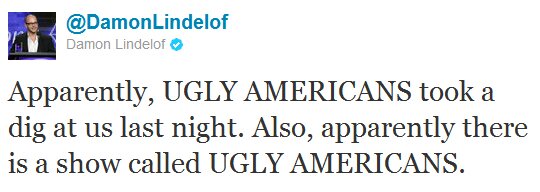
Martin says he’s terrified that he’ll “fuck it up” at the end of the ‘Song of Ice and Fire’ saga and “do a Lost.” Last night, Damon Lindelof reacted to this on :

[HT IO9]
Tags: Damon Lindelof, LOST Finale
Feb 24

Via Assignmentx.com:
“Come on – heaven and hell, man?” says Rodriguez. “I thought you guys were going to get scientific with it, other dimensions with it, like [Stephen] Hawking’s with it, but no man, you had to go the heaven and hell route. It really gnarlied me out. I was saddened by that. I thought they were going to go there. It’s okay. It’s a TV show. Who didn’t enjoy that ride? It was a cool ride – always wondering what’s going to happen.”
While she was only on for two seasons (and a couple of cameos toward the end), she says she relished the time she spent in Hawaii filming the series.
“Hawaii for me, that was home,” says Rodriguez. “I breathed the air there and I was making love to nature. I’m like a lesbo, because nature is a chick, you know what I mean. So I was totally into it and it was more about being in Hawaii and enjoying that experience than anything. It came second nature to me to be working there.”
Tags: Ana Lucia, interview, LOST Finale, Michelle Rodríguez
Dec 08

The Writers Guild of America have announced the nominees for the 2011 Writers Guild Awards. “The End”, written by Damon Lindelof and Carlton Cuse, has been nominated for Best Episodic Drama. However, LOST is not among the nominees for Best Drama Series.
Check out the full list of nominees after the jump.
Read the rest of this entry »
Tags: Awards, Carlton Cuse, Damon Lindelof, LOST Finale, Season 6
Sep 26
LOST is among the TV shows that have earned nominations for the Hollywood Post Alliance’s 2010 HPA Awards:
Outstanding Editing – Television
“Lost – The End”
Mark J. Goldman, Christopher Nelson, A.C.E., Stephen Semel, A.C.E., and Henk van Eeghen, A.C.E. // Touchstone Television
“Glee – The Power of Madonna”
Joe Leonard
“Dexter – Remains to Be Seen”
Louis Cioffi, A.C.E.
“Glee – Dream On”
Doc Crotzer
“Glee – Journey”
Bradley Buecker
Outstanding Sound – Television
“Lost – The End”
Frank Morrone, Scott Weber, Tom de Gorter, Alex Levy, Maciek Malish, Paula Fairfield and Carla Murray // Walt Disney Studio Post Production Services
Read the rest of this entry »
Tags: Awards, LOST Finale
Aug 28
Damon Lindelof Talks LOST Ending, Emmys & More
Cast and Crew of Lost, Interviews, LOST Auction, Post-LOST, Videos View CommentsDamon Lindelof tells GMMR’s Marisa Roffman why he can’t be completely frustrated some people misinterpreted the series finale, what he thought of the recent auction and why the Emmy’s feel like the gang is going away to college.
Tags: Damon Lindelof, Emmys, interview, LOST Auction, LOST Finale, Post-LOST, Videos
Aug 25
Swan Song: Orchestrating the Final Moments of LOST
Cast and Crew of Lost, DVDs & Blu Ray, On The Set of Lost, Season 6, Soundtrack, Videos View CommentsEmmy voters should have watched this before giving the Emmy for best soundtrack to “24″.
[Via ]
Tags: DVD/Blu-Ray, LOST Finale, Michael Giacchino, Season 6, Set of Lost, Videos
Recent Comments